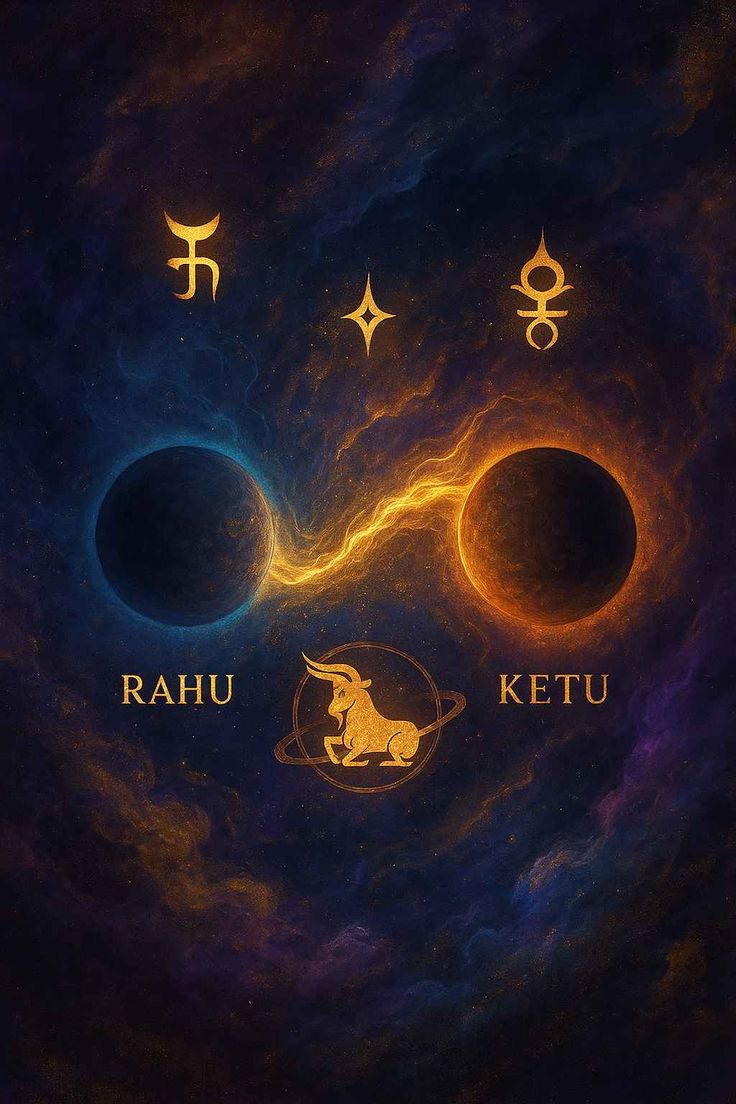
Rahu and Ketu are among the most talked-about, and most misunderstood, points in Vedic astrology. They are not physical planets. They are the two lunar nodes, the points where the Moon’s path crosses the Sun’s apparent path in the sky. Astrologers call them chhaya grahas, or shadow planets, and give them real weight in a birth chart.
The myth behind them
According to the Puranic story, during the churning of the ocean (Samudra Manthan) a demon named Svarbhanu disguised himself as a god to drink the nectar of immortality. The Sun and Moon spotted him and told Lord Vishnu, who cut his head off. The head became Rahu and the body became Ketu. The story is also used to explain eclipses, since Rahu and Ketu are said to chase the Sun and Moon.
What Rahu represents
Rahu is the head without a body: it always wants more. In a chart it is linked with:
- Ambition, desire and worldly success
- Foreign connections, technology and unconventional paths
- Obsession, confusion and illusion when it is afflicted
What Ketu represents
Ketu is the body without a head: it has no ambition to chase. It is linked with:
- Detachment, spirituality and past-life impressions
- Intuition, research and deep focus
- Sudden endings, isolation or a feeling of “something is missing”
Rahu vs Ketu at a glance
| Rahu | Ketu | |
|---|---|---|
| Core theme | Craving and growth | Release and wisdom |
| Direction | Outward, towards the world | Inward, towards the self |
| Lesson | Balance ambition with ethics | Stay engaged while letting go |
Rahu and Ketu Dashas
Rahu’s Mahadasha lasts 18 years and Ketu’s lasts 7 years in the Vimshottari system. Rahu periods often bring big changes, new environments and a strong push for success. Ketu periods tend to turn attention inward and can feel quiet or unsettling before they bring clarity. Results depend heavily on the house and sign involved and on the rest of your chart.
What about Kaal Sarp Dosh?
When all seven planets sit between Rahu and Ketu in a birth chart, many astrologers call it Kaal Sarp Dosh. Opinions differ widely on how serious it is. Many people with this pattern have achieved a great deal, so it should be assessed carefully rather than feared.
Living well with the nodes
- Keep your goals honest and avoid shortcuts during Rahu periods.
- Make space for rest, reflection or meditation during Ketu periods.
- Treat remedies as supportive practices alongside real effort, not a substitute for it.
Wondering which house Rahu and Ketu sit in your chart? Book a consultation with Deep Nakshatra for a personalised reading.
Leave a Reply